We’re eight days from the NHL Draft, with trade rumours swirling at gale force — a perfect time to crack open the mail and answer some pressing questions.
Without further ado …
I think your odds are about 50-50, Derek.
It’s the top priority, even if it’s not the only one, and Kent Hughes has a history of making his biggest moves before July 1.
I know he’s pushing very hard to repeat that history.
But the free agent market isn’t overflowing with quality players. It’s actually quite barren of them, making the trade market a real sellers’ market. And that might make it a little less possible than in recent history for Hughes to acquire what he’s after before your birthday.
If he can’t, send me your address and I’ll send you a card.
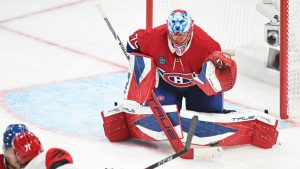
Are we to assume that because Jakub Dobes was remarkable down the stretch and through the playoffs that he’s guaranteed to be Montreal’s starting goaltender for all next season, and that, even if it’s his job to lose and he manages to keep it, it would prohibit Jacob Fowler from playing “a significant amount” of games?
Because if we are, those are some enormous assumptions to make about two goaltenders who have appeared in a combined … (checks notes) … 99 NHL games (playoffs included).
You’re right about Fowler, though. He’s barely 21, and conventional wisdom suggests he needs to play a lot to fulfill his enormous potential down the line, and the AHL will all but guarantee him more playing time than the NHL.
But if the Canadiens trade Samuel Montembeault — there are no guarantees they will, and I’m not even suggesting they should — the door opens for Fowler to play plenty and gain more valuable experience in the NHL, which ultimately might serve his development better.
Even if Dobes plays as well next season as he did from March onward of this past one, Fowler would probably still get into roughly 35 of the 84 games on the Canadiens’ schedule. That’s a relatively safe bet just based on where both goalies are on their developmental curves and how goaltending duties around the league are generally split. And again, that’s assuming Montembeault’s out of the way—either traded, or relegated to being the third goalie in Montreal—and no other goaltender is joining the mix at the NHL level.
Meanwhile, Fowler’s pro development is already in a good spot. He gained 45 games of experience split between Laval and Montreal last season, which is only six fewer than Dobes played as a rookie in Laval.
Dobes then played just 16 with the Rocket and 17 with the Canadiens in 2024-25, which felt suboptimal at the time.
But look where it brought Dobes in 2025-26.
That should inspire confidence that Fowler’s development won’t be underserved by playing a bit less in Montreal than he would in Laval.
I’m going to start backwards here.
I don’t think it’s necessary to include Guhle in a package to net a quality right-hand defenceman.
As a sidebar, I actually think the Canadiens might not have to sacrifice anything more than money to get a quality right-hander on the blue line.
What if Connor Murphy made it to market? Could Hughes get him signed to a deal?
There are some other RHD options likely to hit the market that could prove appealing in the short term.
But even if Hughes doesn’t solve the issue that way, I don’t see shipping Guhle out to solve it as necessary.
I also don’t think it would be remotely wasteful having Matheson, Hutson and Guhle all on the left side of the defence, even with Guhle making $5.55 million.
Considering Guhle’s age and the rising cap, his chances of living up to that contract— or even outperforming it — over five seasons are still quite strong. And having a player as good as him in that position would provide the type of balance and depth on the blue line a perennial Stanley Cup contender yearns for, especially if the Canadiens get another quality right-hander into that mix.
Still, I can acknowledge that’s a luxury. And it’ll only be a luxury if Guhle’s bad injury luck is behind him and his next five seasons prove this last (underwhelming) one was an anomaly.
Because of all that, I can concede Guhle is far from untouchable. And the young, cheaper options lower down the depth chart logically even make him a slightly more expendable.
The surplus at the position could be used to fill a deficit at another.
But I’d be very leery about pushing a player of Guhle’s character and profile out, though. Because, at his best, Guhle brings a lot of what the Canadiens need more of.
It’s tough to answer the first part of this question.
Dach’s status with the Canadiens is currently quite nebulous, despite his rights belonging exclusively to them.
The 25-year-old could be extended a qualifying offer in short order, or he could be traded before it even comes time to hand those out, and both those options are almost entirely tethered to whatever else Hughes has cooking.
If it isn’t much for now, Dach’s will receive his $4-million qualifying offer.
If he rejects it and opts for arbitration — something he’s entitled to do — it won’t change much. His situation will largely be on the back burner regardless.
Now, if Hughes ends up netting the forward piece(s) he’s after before we even get to that, then Dach probably becomes that much more expendable (either in the deal(s) the GM makes to acquire said piece(s) or in a cap/roster-clearing corresponding move).
And there will absolutely be a return for Dach if he’s traded. He’s a six-foot-four, 215-pound middle-sixer, and — even with his injury history and spotty performance since being drafted third overall in 2019 — that’s worth something.
Predicting what it’s worth at this stage is impossible, though. There are too many variables — his unresolved contract, the reasoning behind a potential move, the desired return versus the need to move — to know for sure.
I saw Jimmy Murphy reported last week the Canadiens once again checked in the 23-year-old whose $7-million cap hit runs through 2031, and I can confirm he’s been on their radar.
I can also confirm McTavish was on many teams’ radars going back to the trade deadline — roughly a week before he was first made a healthy scratch in back-to-back games by coach Joel Quenneville.
Quenneville also scratched McTavish for two of Anaheim’s 12 playoff games, which did little to quiet speculation the player and team are headed for a divorce just one season into the six-year, $42-million contract GM Pat Verbeek signed him to.
If the contentious nature of the negotiation, which bled deep into Ducks training camp last fall, cast doubt on McTavish’s future in Anaheim, his wonky performance throughout the season put it completely up in the air.
Still, we’re talking about a 23-year-old who’s never scored less than 17 goals and 41 points in any of his four NHL seasons; a six-foot-one, 219-pound centre who plays at least that big — and with some serious bite when he’s feeling confident.
Even when confident, McTavish’s skating and defensive acumen should cause a team like the Canadiens some pause. Especially if they have questions as to whether he can improve those deficiencies to the extent he’d need to in order to be an ideal fit with them.
It’ll cost something significant to get the player, and his contract would be exorbitant as well if he didn’t develop into a bona fide top-six centre.
Because there are no guarantees McTavish will become one, I don’t think he’s top priority for the Canadiens. They’ve already made their deals for “maybes,” and I don’t think they’re aiming to make another one at this point.
Unless the bargain is too good to pass up.
I’m not convinced either of Arber Xhekaj or Jayden Struble will be moved.
I think there’s a much greater chance one of Adam Engstrom or David Reinbacher ends up on the move if Hughes is able to get what he’s after.
Since St. Louis has been coach, he’s had three assistant coaches. Trevor Letowski and Stephane Robidas have been mainstays on the bench, and though Alex Burrows is no longer alongside them there, he still remains on staff.
Roger Grillo was also brought in as an extension of the coaching staff.
All the Canadiens coaches are going into their last season under contract, so we’ll see if any changes come. I’m not convinced any will, but you never know.
Considering the Canadiens were the second-most successful team in the NHL in exiting their zone in control of the puck in all situations last season (according to SportLogiq), I don’t think that’ll be a specific focus.
But it’s not as if the team is instructed to never punt the puck.
As St. Louis always says, “Play the game that’s in front of you.” He doesn’t have hard rules on whether to skate the puck out, pass it, or punt it; he just wants players to make the right reads and react accordingly.
If those reads and reactions lead to you maintaining possession more than all but one team in the league, that’s a good thing.
I mean, if the Canadiens get 102 points instead of 106, if they lose in the second round instead of the third, if Nick Suzuki scores less than 100 points and doesn’t repeat as the Selke winner, and if Cole Caufield scores less than 50 goals, I suppose those could all be seen as steps backward.
I’m not suggesting any of those things will happen, but the Canadiens — as a team and individually — raised the bar to a level they aren’t guaranteed to reach or exceed next season.
I understand that even if they’re that much more experienced, and even if they improve considerably on paper this off-season, the general perception of their growth (or lack thereof) will be based on results.
But even if the numbers fall underneath that high bar, I can’t envision the process of getting closer to becoming a perennial contender being halted at this stage.
I’d be shocked.
Touching base with sources on this file, it sounds as though we’re still in the preliminary phase of Gallagher trade talks — mostly because potential acquiring teams have some bigger fish to fry at this stage.
Agent Gerry Johansson is working with Hughes to get this sorted properly, and both parties remain confident it’ll get sorted ahead of training camp.
I’ll say if he signs for eight years that the annual average comes in at $9.5 million.
I think these are the questions Hughes is grappling with as he assesses the market. He’s in competition with several other teams to acquire a centre, and he’s more than willing to give up premium assets for the right one.
But the Canadiens GM isn’t going to unload for just any player who qualifies as a second-line centre. Especially not with elite prospects like Hage and Alexander Zharovsky knocking on the door.
Quality and fit are what matter most.
That goes for any position Hughes is aiming to improve.
Second-line centre certainly isn’t the only one, so I don’t think Hughes will turn away from premium or depth wingers — particularly if they bring speed, skill, size and grit to the Canadiens.
I think both Mason Marchment and Alexis Lafreniere would both qualify as interesting pieces to the GM, though I’m not sure he would pay to beat the market on either.
When Slafkovsky moved to a line with Demidov and Oliver Kapanen last season, he essentially played as the centre.
He just wasn’t taking the face-offs.
That’s kind of how the game works now. Especially the Canadiens’ game, which features a lot of roving from position to position.
Given that, I think we’re a little too fixated on labels.
Still, acquiring a natural centre remains a better solution than counting on Slafkovsky or Demidov to fill that space.